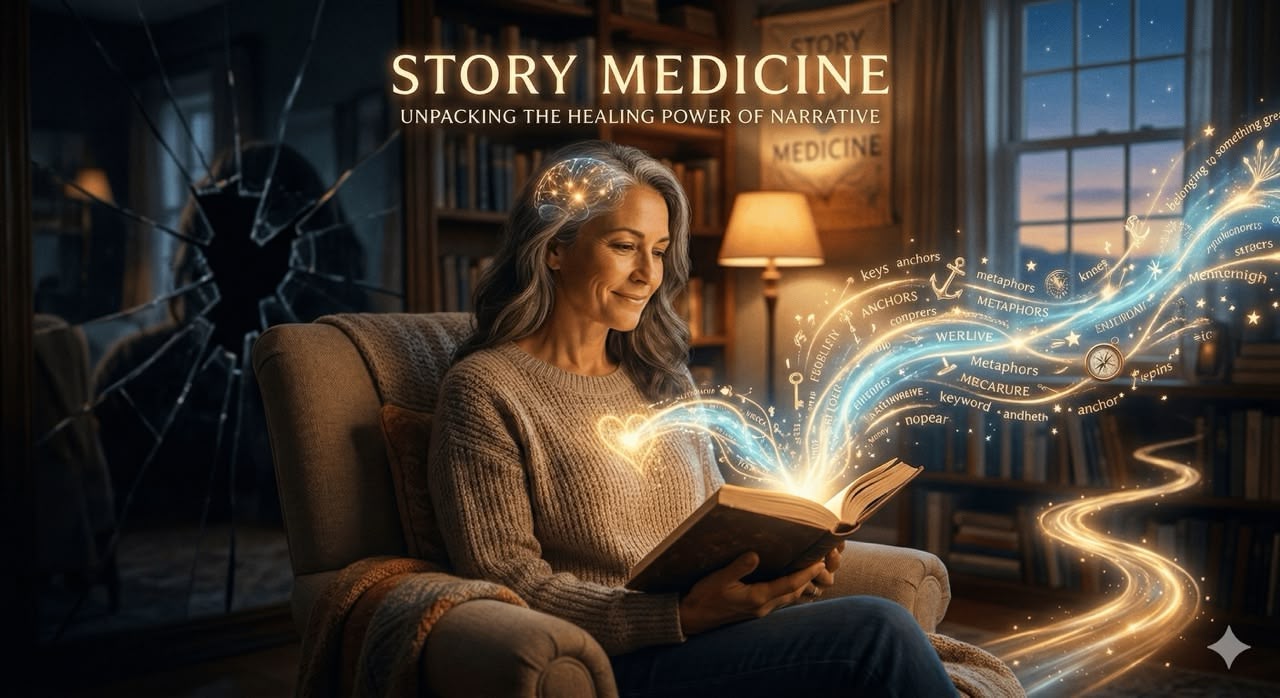
Today, we are opening up the toolkit and unpacking the transcripts from Phoenix's latest supplemental conversation. Building on that foundation, we will explore how our minds are literally wired to heal through narrative, and how Phoenix applied this to their own recovery from profound trauma.
Story is not an entertainment box.
When we think about our health and wellness, we often compartmentalize. But as humans, we are intertwined systems. Story has direct, physiological effects.
Emotional Body
What we experience, our ability to think, and how we process emotion are driven by neurotransmitters and hormones triggered by narrative.
Mirror Neurons
When you hear someone's lived experience, your mirror neurons are simulating that experience. You are feeling it.
Spiritual Connection
Story provides feelings of peace, hope, and connection to something greater than ourselves—whether that is a specific tradition, humanity, or a simple sense of belonging.
Adaptability
Story creates symbols and metaphors that build intellectual flexibility. It helps us see ourselves differently and meet challenges outside of our previous family or community experience.
The exciting part? I don't have to think about it. I don't have to manage it. My brain is wired for story through thousands of years of evolution. It is doing what it needs to do without me directing it.
Tunnel Vision: The Warning
There is a catch to this effortless process: the brain unconsciously fills in gaps. It makes connections that might not be accurate.
If the community or setting I am in is skewed or limited, my information is skewed. My unconscious mind can reinforce previous, unhealthy belief systems. This is why story finds us, but also why we must pay attention. We must move from tunnel vision to a wide-angle lens.
Growing Up in Funhouse Mirrors
Phoenix describes growing up chronologically, emotionally, and intellectually within a self-help mutual aid community, beginning their healing journey just before their 18th birthday.
Prior to that, Phoenix's family system was inundated with generational trauma, chronic stress, and toxic stress, which completely impacted their ability to function.
“I used to refer to it as growing up as if I were sitting in front of funhouse mirrors. You would go in, and the glass would be warped in different ways. The image looking back at you was distorted. And so my perception of myself, my perception of life, and my perception of healthy relationships really was not accurate.”
— Phoenix
The breakthrough came when Phoenix entered a community committed to recovery. All of a sudden, they were in an environment where people were sharing their “experience, strength, and hope.”
Sitting there, desperate to have a different life experience, Phoenix listened intently, looking for identification—knowing “I am not alone, I am not unique.” Here, they could learn different approaches to life. We filter these shared stories: “Oh, yes, I want to do that,” or, “No, that is not for me.” Personal story has this effortless, powerful effect.
Beyond Labels: The Danger of Skewed Narrative
We must be careful not to create new “skewed” narratives, even in recovery. About three years into their journey, Phoenix met a childhood friend. Phoenix was enthusiastically sharing their progress, explaining that they now understood that every single emotion they had ever experienced was part of their substance use disorder.
“Fix, I have all of those same feelings and I am not an alcoholic!”
— Phoenix's childhood friend
That moment was profound. It was a sharp injection of new information.
“This is new information. I have complex trauma history... many things that we as individuals are navigating and experiencing. And I can forget that it's not just me—it is part of a human experience.”
— Phoenix
It was a vital reminder that we are complex human beings first, not defined solely by a diagnosis or a trauma history.

Steep Hills and the Subconscious Key
Perhaps the most powerful example of story medicine is how it surfaces exactly when needed, entirely unprompted.
Phoenix describes a grueling, early morning bike ride in their 20s. It was cold, they were cranky, and they were approaching a short but steep hill. Their muscles felt like steel bands, their legs like lead. At the bottom of the hill, the legs refused to go. Standing up in the toe clips and forcing the crank, an unexpected phrase burst from their mouth:
“I think I can.”
Phoenix was jarred. There was no conscious thought. Who saw me? Who heard that childish phrase? Only a squirrel. But instantaneously, Phoenix connected with sudden energy in their legs. They continued, chanting: “I think I can. I think I can. I know I can.”
They got up the hill effortlessly. At the top, a cheer.
“I went, ‘Whoa! Oh, there is something to this story business.’ A story image from my childhood that I hadn't thought about in probably close to 18, 19 years at that point came out of my mouth at the exact moment I needed it.”
— Phoenix
This realization helped Phoenix approach symbols and metaphors consciously in their healing work. Stories seemed to find them. Every story provided the exact symbol or metaphor that was like a key in a lock. In times of struggle, the brain searches for the right key. It knows intuitively just what you need, provided you are paying attention.
Closing Thoughts
We cannot belabor the point or tell every story. But we can contemplate how story affects us.
“How have different interactions or hearing different speakers share from their personal heart experience and deliver a message that you needed just when you needed it most? And when have you provided that for someone else? We are all in this together and the power of story speaks from one's heart to another.”
— Phoenix
We look forward to the journey ahead.
Story Medicine: Reflection & Discussion Prompts
To help you explore the concepts of Story Medicine, we have created this toolkit for personal reflection or group discussion. How has story found you and healed you?
1. Identifying the “Funhouse Mirrors”
Phoenix describes growing up with a warped perception of themselves due to trauma.
The Prompt: Looking back at your early life or a difficult period, what was a “distorted” belief you held about yourself? (e.g., “I am a burden,” or “I am not capable.”)
The Shift: What is a “straight mirror” story—a piece of evidence or a shared experience—that has helped you see a more accurate, healthy version of yourself today?
2. The Power of “Not Unique”
We often feel our struggles are so specific that no one could understand. Phoenix found healing in realizing their emotions were part of the universal human experience.
The Prompt: Can you recall a time when someone shared a story and you thought, “Oh, thank God, it's not just me”?
The Action: How did that realization change your physical or emotional state in that moment? Did you feel a release of tension, a sense of hope, or a new connection?
3. Finding Your “Subconscious Keys”
Sometimes a childhood story, a song lyric, or a movie scene pops into our heads exactly when we need it—like Phoenix's “I think I can” moment.
The Prompt: Is there a symbol, metaphor, or specific story character that resonates with you during times of “impasse” or struggle?
The Exploration: If that symbol (an animal, a fictional hero, a natural element) could give you one piece of advice right now, what would it be?
4. Beyond the Labels
It's easy to let a diagnosis or a specific life challenge (like “recovery” or “trauma survivor”) become our entire identity.
The Prompt: Aside from any labels or roles you carry, what are the core “human” emotions or qualities you are experiencing lately?
The Growth: How does acknowledging your shared humanity (the fact that everyone feels anger, fear, or joy) help you feel more connected to the world around you?
5. Acting as the Storyteller
We are all “storytellers in residence” for the people in our lives.
The Prompt: When was the last time you shared a “piece of your heart”—a lived experience—with someone else?
The Reflection: What did it feel like to offer your “experience, strength, and hope” to someone else? How did telling your story help you heal a little more?
About the Source
This post is an exploration and “unpacking” of the concepts presented by Phoenix, a Storyteller in Residence for the New York State Trauma Informed Network and Resource Center.
To experience the full depth of the original work, we highly recommend reading the foundational article: Story Medicine: The Science and Wisdom Behind the Healing Power of Story.
The New York State Trauma Informed Network is dedicated to supporting organizations and individuals in becoming trauma-informed, offering resources that foster healing, resilience, and connection across the state.